

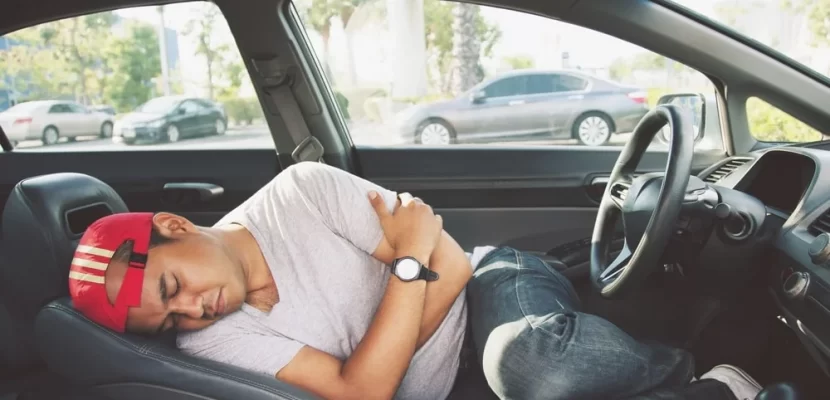
It is a scenario that plays out in parking lots across the country every weekend. You attend a social gathering, realize you have had one drink too many, and make what feels like the most responsible decision possible: you refuse to drive. Instead of risking an accident or an arrest on the open road, you recline the driver’s seat, wrap your jacket around your shoulders, and decide to sleep off the alcohol until morning.
Hours later, you are startled awake by a flashlight beam cutting through the side window and a police officer tapping on the glass. By the time the encounter ends, you find yourself under arrest, booked into a county detention facility, and charged with driving under the influence.
To most drivers, this outcome feels absurd, unfair, and deeply counterintuitive. You chose specifically not to drive, yet the legal system treats you as if you were caught speeding down an interstate. The reality is that in almost every state, you can face criminal DUI charges for simply sleeping in a vehicle while intoxicated. Understanding why this happens requires looking past the word “driving” and examining how criminal statutes define vehicle control.
The Legal Standard: “Actual Physical Control” Explained
The fundamental disconnect between public common sense and traffic law comes down to statutory phrasing. Most people assume a DUI requires an automobile in motion. However, criminal codes across the United States rarely restrict impairment offenses strictly to the act of driving. Instead, the statutes generally prohibit driving, operating, or being in actual physical control of a motor vehicle while impaired by alcohol or drugs.
The phrase “actual physical control” expands police power significantly. While definitions vary across state lines, the concept generally means that an individual has the immediate, present ability to operate the vehicle, manage its mechanism, or put it into motion.
Lawmakers drafted these laws with prevention in mind. The public policy rationale is straightforward: an intoxicated person inside a motor vehicle poses a latent danger to public safety. An individual sleeping off a night of drinking could awaken in an impaired haze, decide to resume driving before their blood alcohol level returns to zero, or accidentally knock the gear selector into drive while shifting in their sleep. Because legislatures view a motor vehicle as a dangerous instrumentality, the law seeks to intervene before an intoxicated person ever touches the gas pedal.
In practical terms, you do not need to be traveling down a boulevard with your hands on the steering wheel to commit an offense. If an officer determines that you possessed the immediate means to set the car in motion, you meet the statutory threshold for actual physical control.
The Totality of the Circumstances: How Officers and Courts Evaluate You
Because sleeping in a vehicle sits in a legal gray area between innocent resting and imminent driving, judges and juries do not decide these cases on a single detail. Instead, courts apply a legal standard known as the totality of the circumstances.
Under this balancing test, prosecutors and defense attorneys weigh an array of contextual factors to establish whether you were merely using the car as stationary shelter or maintaining active dominion over the machinery.
Key Placement and the Challenge of Push-to-Start Fobs
Historically, the location of the physical key was the centerpiece of an actual physical control investigation. If the key was resting inside the ignition cylinder, conviction was nearly guaranteed, even if the engine was shut off. If the keys were stored outside the vehicle or locked in the trunk, defendants had a powerful argument that they lacked the mechanical ability to start the engine.
Modern vehicle technology has made this standard considerably more complex. With keyless ignitions and push-button start systems standard in modern automobiles, a driver no longer needs to slide a metal key into a steering column. The proximity of a smart key fob inside the cabin is often all that is required for an engine to fire up with a tap of the foot and finger.
If a key fob is resting in your jacket pocket, sitting in the center console cup holder, or lying on the passenger seat, prosecutors will argue that you retained immediate, push-button capability to launch the vehicle into traffic.
Seating Position Inside the Cabin
Where you choose to sleep inside the vehicle plays a pivotal role in how law enforcement interprets your intent.
Sleeping upright or reclined in the driver’s seat places you behind the primary operating controls. Your hands are adjacent to the steering wheel, and your feet sit inches from the brake and accelerator pedals. This setup gives officers probable cause to suspect you either just drove to that location or were preparing to drive away.
Conversely, sleeping stretched across the backseat or curled in the cargo area of an SUV provides a much stronger defensive argument. It shows a physical detachment from the controls, supporting the claim that you made a conscious choice to take yourself out of the operator position.
Engine Status and Climate Control
Weather frequently forces sleeping drivers into legal traps. Freezing winter nights and humid summer evenings make sleeping inside an unconditioned metal cabin dangerous or miserable. Naturally, drivers start their vehicle to run the heater or air conditioning.
Turning on the engine—even if purely for warmth or cooling while in park—is often viewed by courts as definitive proof of operation. A running engine means mechanical systems are engaged, fuel is burning, and the transmission can be shifted into gear in a fraction of a second. Even leaving the key turned to the accessory mode to listen to the car radio can be introduced by prosecutors as evidence of active physical control over the vehicle’s electrical equipment.
Parking Location and Vehicle Orientation
The physical environment where the car is found tells a story to investigating officers.
A vehicle parked legally between painted lines in a private parking lot outside a restaurant, sports arena, or commercial bar presents a compelling picture of someone choosing to stay put after an evening out.
Contrast that with a vehicle pulled onto the soft shoulder of an interstate, angled awkwardly across an exit ramp berm, or stopped with its hazard lights blinking at a red light. In those scenarios, officers and prosecutors will reasonably infer that you drove while intoxicated, succumbed to sleepiness or intoxication while moving, and pulled over after the driving had already taken place.
Physical Indicators of Recent Driving
Even if an officer encounters you sound asleep with the engine off, circumstantial evidence can prove recent operation. Police look for tangible clues:
-
A hood or radiator that feels warm to the touch on a cold night.
-
Headlights, taillights, or interior dome lights left illuminated.
-
Exhaust pipes ticking from residual operating heat.
-
A vehicle transmission left resting in neutral or drive with the parking brake engaged.
-
Fresh tire tracks through mud or grass leading to where the car is resting.
If physical evidence suggests you operated the vehicle minutes before falling asleep, prosecutors do not need to rely on the actual physical control doctrine; they can charge you with past driving under the influence supported by circumstantial proof.
State-by-State Differences: Strict Liability vs. the Shelter Defense
State laws diverge significantly when it comes to penalizing drivers who sleep off intoxication in stationary cars. Across the nation, judicial frameworks fall roughly into two competing philosophies.
Strict Enforcement Jurisdictions
In states with aggressive statutory language, such as Arizona, Florida, and Oklahoma, courts interpret actual physical control strictly. In these jurisdictions, prosecutors rarely need to prove you intended to drive. The mere presence of an intoxicated person inside an operable vehicle with access to the keys is frequently enough to secure a conviction.
In Arizona, for example, long-standing legal precedent instructs juries to evaluate whether the defendant presented an active hazard to others. Even if an individual was sound asleep, the presence of the keys inside the vehicle cabin often leaves the question of actual physical control entirely in the hands of the jury, with many trials resulting in guilty verdicts.
States Recognizing the “Shelter Defense” or Operability Requirements
Other jurisdictions take a more forgiving view, recognizing that penalizing motorists who deliberately choose not to drive creates a dangerous public incentive. These states have developed what defense attorneys call the shelter defense or temporary sanctuary doctrine.
In these states, courts hold that an intoxicated person who uses their stationary car solely as a bed should not be treated as a criminal motorist, provided they took clear steps to disable their ability to drive.
Judges in these states look closely at whether the vehicle was parked in a safe, lawful spot, whether the keys were removed from the driver’s immediate reach, and whether the defendant exhibited any intent to set the automobile in motion. If the evidence confirms the car was functioning strictly as stationary temporary lodging, charges may be dismissed before trial.
The Reality of the Police Encounter
When an officer approaches a parked vehicle with someone asleep inside, the initial contact is almost always classified as a welfare check. Police officers have a legal duty under their community caretaking function to check on individuals slumped over inside cars to verify they are not suffering a medical emergency, carbon monoxide poisoning, or a drug overdose.
Once the officer taps on the glass and you roll down the window, the nature of the encounter shifts instantly. If the officer smells alcohol, spots bloodshot eyes, hears slurred speech, or sees alcoholic beverage containers in plain view, the welfare check transforms into a criminal DUI investigation.
From that moment onward, the standard machinery of a traffic stop takes effect:
-
The officer will ask where you came from, where you were going, and how much you drank. Answers provided on scene become prime evidence against you.
-
You will likely be asked to step out of the vehicle to undergo standardized field sobriety tests, including the horizontal gaze nystagmus, walk-and-turn, and one-leg stand assessments.
-
If the officer establishes probable cause, you will be arrested and transported to a station or medical center for a formal breath, blood, or urine chemical test.
Under the implied consent laws active in all fifty states, refusing a chemical test after a lawful arrest for being in actual physical control of a vehicle carries automatic administrative driver’s license suspensions, regardless of whether you were asleep when the officer first arrived.
Practical Steps to Protect Yourself If You Have No Alternative
The safest, most legally secure choice is straightforward: never sleep in your vehicle while intoxicated. Calling a rideshare service, hailing a traditional taxi, reserving a nearby hotel room, or arranging a designated driver completely removes the risk of an arrest.
However, life happens. Cell phone batteries die, rural destinations lack rideshare coverage, and emergency circumstances leave people stranded. If you find yourself in an absolute crisis and have no alternative but to sleep in your vehicle while intoxicated, you must take active, deliberate steps to eliminate any appearance of actual physical control:
-
Relocate the Keys Completely Out of Reach: You must physically sever your access to the vehicle’s ignition. If your car utilizes a traditional metal key, lock it inside the trunk. If you drive a hatchback or SUV without an isolated trunk, place the keys in an exterior magnetic lockbox, tuck them deep into a wheel well, or hide them beneath a tire.
-
Handle Smart Fobs with Caution: For push-to-start vehicles, placing a fob in the trunk or hiding it on an exterior tire may still allow the proximity sensors to detect the signal. Test your vehicle beforehand to know where the dead zones are, or place the fob inside a signal-blocking Faraday bag before stashing it out of arm’s reach.
-
Sleep Strictly in the Back Row: Never recline in the driver’s seat. Move to the backseat, recline across the rear bench, or climb into the cargo area. If you have a blanket or sleeping bag, use it; it reinforces the factual argument that you were treating the vehicle as a bed rather than a driving platform.
-
Keep the Engine Off at All Times: Do not start the car for heat, air conditioning, or music. If the climate makes staying in the cabin unbearable without climate control, you cannot safely remain in the car; seek shelter inside a 24-hour commercial establishment instead.
-
Park in a Lawful, Designated Space: Ensure your car is parked entirely within the legal markings of a safe, authorized parking spot. Avoid private lots with active towing policies, do not park on highway berms or road shoulders, and never stop in red zones or loading alleys.
Choosing to sleep off intoxication in a vehicle shows an admirable desire to keep other motorists safe, but criminal traffic statutes prioritize preventative public protection over personal intentions. Knowing how actual physical control works ensures that a safe personal choice does not lead directly to a courtroom.